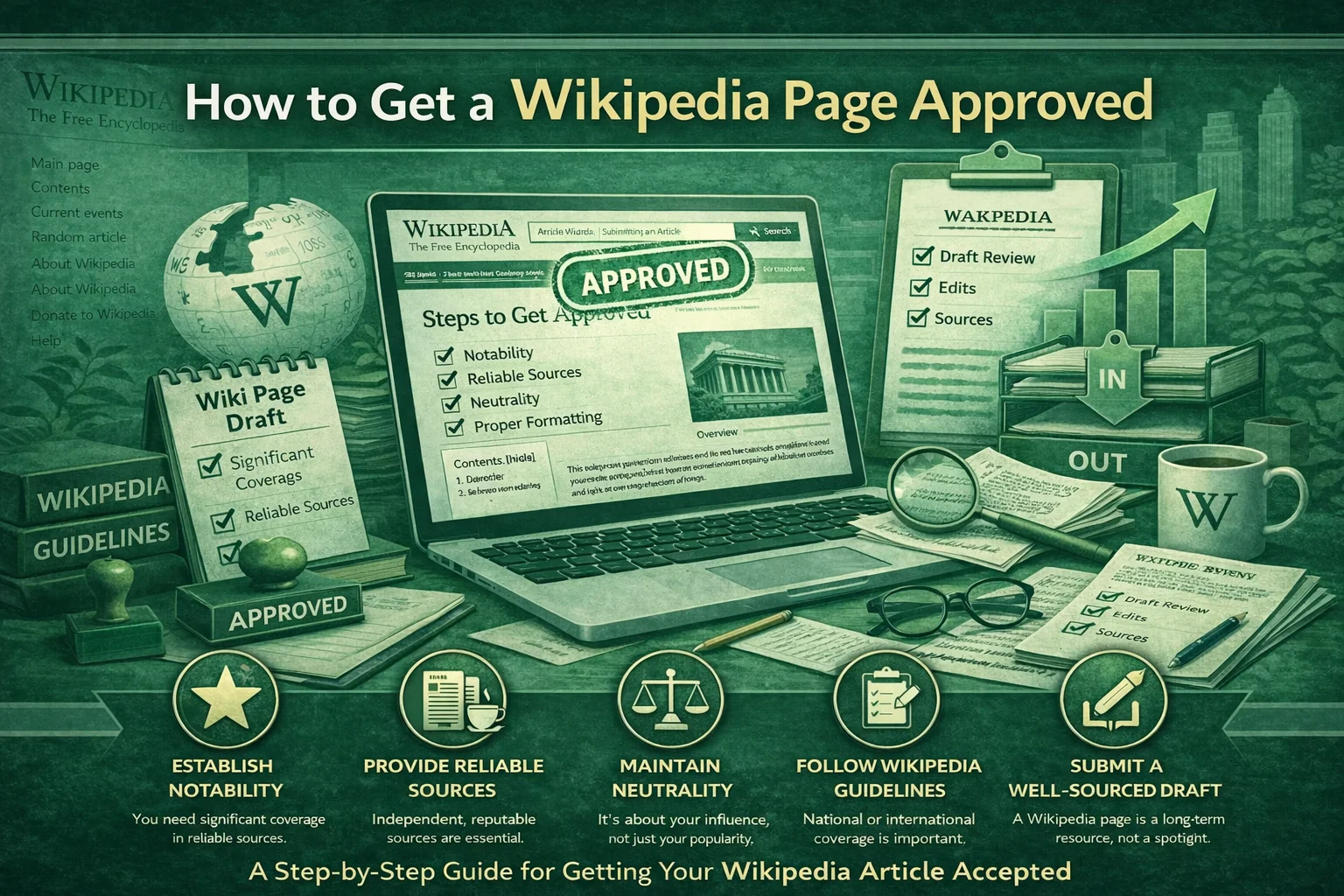


Wikipedia pages are maintained (or are removed) according to at least one criterion: verifiability. It implies that the content of a page has to be supported by authoritative, published content- not personal assertion, not promotional text, and not the appeal to authority. Credible Sources are the best starting point to construct any draft as fast as possible.
The Importance of Credible Sources Over Writing Style
Even a well-written draft might be removed when it does not have good references. Wikipedia would require assertions, particularly those that may be disputed, to be identified with credible sources, which have been edited. The standard is even higher when it comes to living subjects.
Step 1: Understand what Wikipedia regards as credible
Fact-checking and accuracy, combined with an editorial process (editors, review, corrections, accountability), is often considered to make a source reliable. Academic and peer-reviewed publications tend to be ranked high, and mainstream news coverage can be very potent, provided it is more factual reporting and not opinion-only commentaries.
Another useful tip: Credible Sources are written on the subject, not by the subject. The difference safeguards impartiality and minimises bias.
Step 2: Focus on independent, 3rd-party coverage
On the creation of Wikipedia pages, independence is a no-no. Basic details can be checked by a company website, a personal blog of an author, a press release, or a self-published bio, but they can rarely achieve any real-life meaning since this is not a self-sufficient source. The sourcing principles listed by Wikipedia always tend to lean towards third-party content to create credibility and notability.
A source can be rejected (or assigned a very low weight) if it has some sort of connection with the subject financially, professionally, or editorially.
Step 3: Identify meaningful coverage, not passing mentions
One fast shortcut trick: gathering ten links that only say the subject in a single line. Wikipedia appreciates extensive coverage, a profile, a feature, an inquiry with editorialization, an interview, or a treatment at the scale of a chapter in a well-respected book.
A practical test:
- Strong: an article first about the person/company/event.
- Weak: listicle post, a directory post, a quick quote in a roundup, or a press release copy.
This is the distinction between evidence and noise.
Step 4: Search the best places to find Credible Sources
A clever research sweep usually consists of:
Books and educational databases
Quality discussion may be found in academic databases and academic search engines, particularly with technical, medical, historical, or cultural topics.
News archives and published publications
Large stores typically have big archives. Older coverage may be useful as it will indicate that attention was not a weeklong spike.
Publications of reputable publishers
Exceptional secondary sources may be books (particularly reputable publishing houses) that devote significant space to the subject matter.
The sourcing tools of Wikipedia itself
Wikipedia has a Reliable Sources checklist that attempts to assess the suitability of a given source, and a Perennial sources list that attempts to summarize community consensus on sources that come up on debatable lists. The pages prove to be very helpful when a source is in a grey area.
Step 5: Search as a researcher and not as a casual browser
The fastest way to find Credible Sources is to employ tricks to minimize junk results:
- Search name (abbreviations, older names, alternate spellings).
- Combine the topic and profile, interview, investigation, review, case study, award, lawsuit, conference, publication, or journal.
- Sort marketing junk using negative terms (filter out press releases, sponsored, or even the brand itself).
The point is to bring out the editorial coverage first, then fill in the details afterwards.
Step 6: Filter sources using a basic quality checklist
Before saving a link, ask:
- Is it subject independent?
- Is it editorial and fact-checked?
- Is the author recognizable and competent on the topic?
- Is it either reporting (strong) or is it simply opinion/promotional (weak)?
- Does it offer anything more substantial than a cursory mention?
- Is it verifiable (no guesswork) by going directly to the source?
Wikipedia itself informs on the need to evaluate reliability in terms of the situation, and recommends that sources be evaluated in terms of the claim under support.
Step 7: Prevent typical source traps, which result in rejected pages
Such are common causes of draft failures:
PR write-ups and press releases
They tend not to be independent and are even likely to be promotional. Apply them sparingly, and, in any case, not as the foundation of notability.
Advertorials and sponsored material
Although this may seem on a familiar page, sponsored usually translates to paid placement, which undermines independence.
Self-published material
Personal blogs and self-created biographies are seldom considered Credible Sources of determining significance.
Conflict of interest sourcing behaviour
Wikipedia does not encourage people to edit in their own interests, and paid relationships must be reported. A conflict of interest raises questions even when the writing is factual – the sourcing should therefore be particularly robust.
Step 8: Build a “source pack” before drafting the article
For smoother Wikipedia page creation, collect sources first and organise them:
- Save the full link, publication name, author, and date.
- Note what each source covers (bio details, awards, controversies, timeline, reception).
- Match each major claim to at least one strong citation.
- Prefer multiple independent sources for major statements (cross-checking reduces errors).
This approach prevents drafts from turning into a patchwork of weak references.
Step 9: When a source is questionable, check community consensus
Some outlets are frequently debated. Wikipedia’s Perennial sources page summarises prior discussions and typical outcomes for many sources. It does not replace judgement, but it helps avoid preventable mistakes when selecting Credible Sources.
Final thoughts: Credible Sources create “stability”
Wikipedia rewards pages that are built on strong, independent references. The most effective strategy is simple: collect Credible Sources first, confirm significant third-party coverage, and draft only after the source pack is solid. That structure protects the article from deletion debates and makes the content easier to keep neutral and verifiable.