

The presence of a company on Wikipedia can seem like a very strong sign of credibility for many organizations. An article well written with reliable sources may provide potential readers with information about the company’s history, management, product line, and its impact on society.
But creating a Wikipedia page for your company is not the same thing as the About Us section or the publication of a press release. Wikipedia is an encyclopedia, not a marketing tool. In order to have an article approved and not deleted, the company has to pass several tests of credibility, sourcing, neutrality, and conflict of interest.
So, the question is: Can you create a Wikipedia page for your company? Yes, but whether it will survive depends on the media coverage.
Can a Company Have a Wikipedia Page?
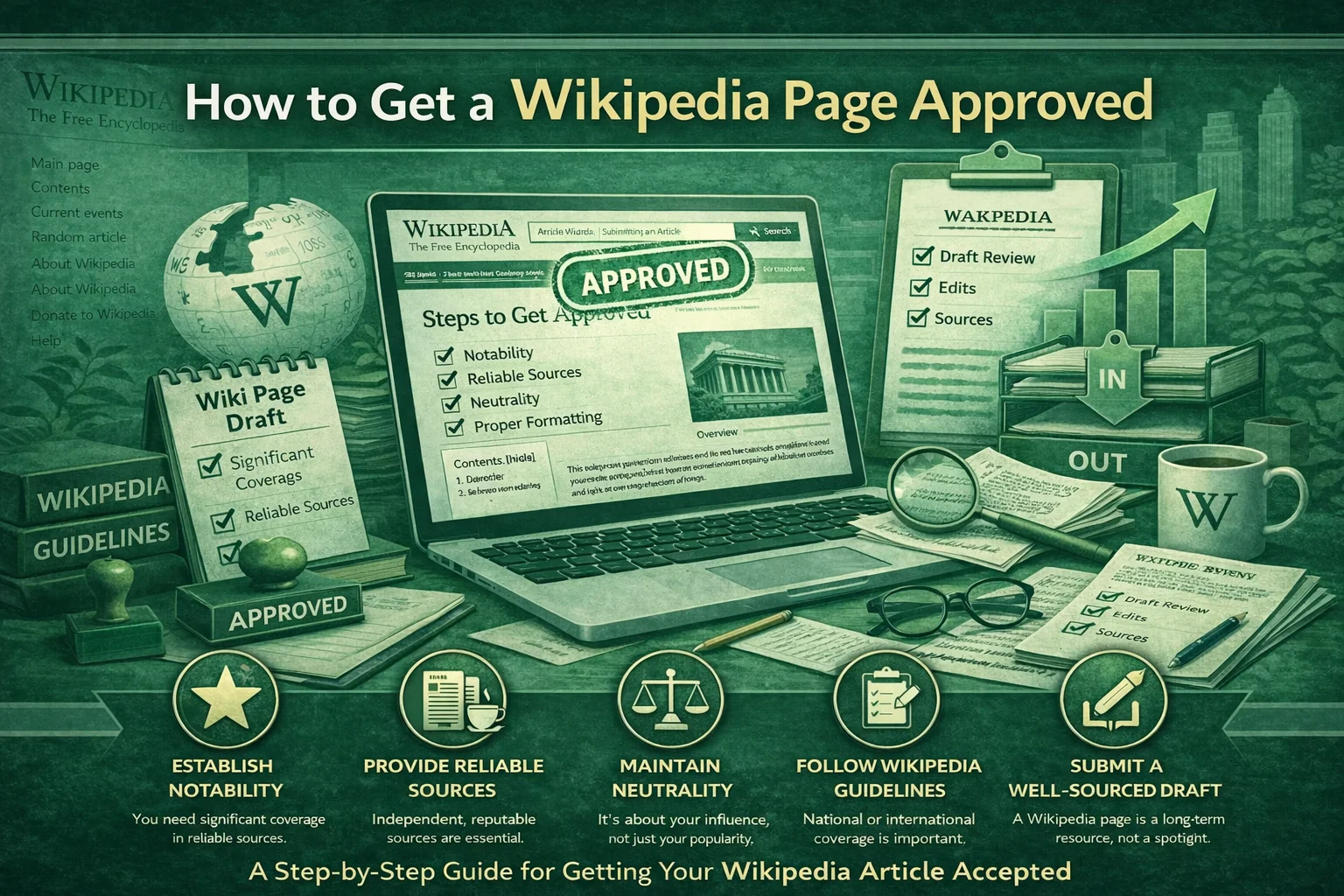
To get a Wikipedia article, a company needs to be notable according to Wikipedia’s rules. Basically, this means there should be a good amount of information about the business in reliable sources that aren’t connected to the company. This could be things like in-depth articles, features, or stories in books, newspapers, magazines, or well-regarded industry journals. Just a quick mention here and there usually won’t cut it.
The important part is that the sources have to be independent. Things like the company’s own website, their social media, press releases, ads, or anything that looks like a paid promotion typically don’t count as proof of notability because the company controls them or is closely tied to them. Wikipedia aims to be a summary of what’s already out there in trustworthy sources.
Why Notability Matters
The most frequent error is equating the success of the business with its notability on Wikipedia. It is possible for the company to make good profits, have thousands of clients, a large number of followers on social media, and many years of operation but still fail the criteria of notability. For Wikipedia, the issue is not whether the company is commercially successful; it wants verifiable public significance.
Before writing your draft, you should first consider:
- Have the company’s activities been covered in depth in reliable publications?
- Are these publications independent of the company?
- Have they covered the company in detail instead of mentioning it in passing?
- Is the coverage sufficient enough to write an unbiased article without much company information?
If not, it might be wise to create some real coverage first.
Understand Wikipedia’s Conflict-of-Interest Rules
Another critical aspect that one needs to consider is conflict of interest.
Wikipedia has policies that require individuals not to edit content where there is a financial or professional conflict of interest. Such conflicts of interest can apply to companies’ owners, founders, employees, public relation officers, marketers, and paid editors. An individual having a conflict of interest with a company will experience difficulty writing about the company objectively.
In addition to the above, paid contributors must declare their affiliation to the employer and clients before any paid editing. Concealing paid editing can cause severe consequences to both parties.
In case of conflict of interest, one must ensure transparency at all times. It is wise to use the process provided by Wikipedia for suggesting changes and submissions of drafts for independent assessment.
Write in a Neutral, Encyclopedic Tone
In writing an article on Wikipedia, one must make sure that the tone is encyclopedic and not promotional.
Terms such as “leading provider,” “world-class company,” “industry pioneer,” “used by thousands,” or “best-in-class solutions” must be avoided.
Instead of saying:
“ABC Technologies is a leading software company providing innovative solutions across the globe.”
The neutral statement would be:
“ABC Technologies is a software company established in 2015 that provides cloud-based solutions to retail companies.”
Use Reliable Independent Sources
Sources are the backbone of a solid Wikipedia article. Any assertion must be backed up by credible sources. Strong sources include credible newspapers, magazines, respected trade publications, published books, and credible news agencies.
Weak sources include corporate blogs, social media postings, press release distribution agencies, paid content, self-published content, and web pages that merely parrot the business information. The quality of the source is more important than the number of sources. Ten weak sources are not necessarily more valuable than three strong independent feature stories.
What Should a Company Wikipedia Page Include?
If the firm meets the criteria, the article should emphasize information that can be documented using published sources.
- Introduction: Begin the article with a summary of the firm, including what the firm does, its industry, its base, and some of its key features.
- History: This would include major events such as founding, expansion, acquisitions, change in leadership, or any other events supported by sources.
- Products/Services: Firms’ major products, platforms, or services can be briefly mentioned when there is sufficient independent coverage.
- Operations: The information could include offices, business model, scope, divisions, or organization.
- Recognition/Publicity: Any major awards, partnerships, controversies, legal issues, or any other major events that have been widely reported could be included, provided sources can be cited.
An even-handed article could cover both positive and negative major coverage. Wikipedia should not be used for reputation management.
Best Practices for Creating a Company Wikipedia Page
- Begin with a notability audit. Find your best independent sources before creating the article.
- Second, categorize your sources based on what facts they support. This will help avoid including unsupported facts in the draft.
- Write conservatively. Add only those facts that belong in an encyclopedia. Mission statements, client testimonials, sales claims, discounts, and other calls to action are inappropriate.
- Add citations throughout the article to allow verification of facts.
- Disclosure is better than hiding your connection with the company if there is a conflict of interest.
- Finally, get ready for community editing. Wikipedia editors may doubt your sources, rewrite some parts, edit away promotional language, or reject the submission altogether.
Common Mistakes That Can Get a Page Rejected or Deleted
There are a few mistakes that commonly lead to the failure of company pages.
- First is lack of notability. If the majority of references are provided by the company, the article might not meet the requirements.
- Second is promotional language. It is very easy for Wikipedia editors to recognize promotional writing.
- Third is poor sourcing. News releases and sponsored placements cannot be used instead of independent references.
- Another common mistake is direct copying of information from the company’s webpage. In addition to being promotional, this could create copyright issues.
- Finally, businesses must not hide paid relationships or keep restoring deleted promotional content.
Unless your company already enjoys adequate coverage from the independent press, it’s almost always a bad idea to insist on creating a Wikipedia page. Your efforts should be devoted toward making yourself a more notable organization by way of genuine media coverage, business research, interesting projects, and accomplishments. The objective should not be to create notability, but to gain enough notoriety that the independent press covers your company.
When this is done, an article on Wikipedia becomes a possibility.
Final Thoughts
A company can have its own Wikipedia page, however, having a company does not necessarily guarantee the right to have one. There are certain requirements to be met, such as independent coverage, credible sources, neutral tone, disclosure of conflicts of interest, and being beneficial for the reader, not just the advertiser.
At the very beginning, you should assess whether your company is notable at all. If it is, then write about it using independent sources and facts; if it is not, then you should work on getting some coverage first.
The best company pages on Wikipedia are those which are not advertisements in the disguise of articles. They are well-researched pages about companies which have already attracted a sufficient amount of attention.